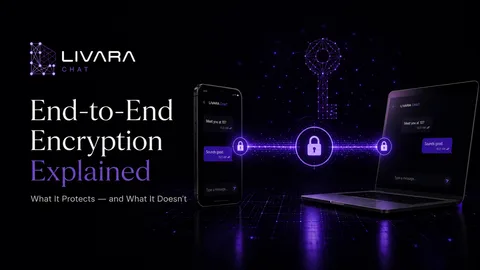
End-to-end encryptionUnderstand the seal. Know its limits.
✳01
End-to-end encryption explained: message keys, encrypted groups, verification, recovery and the boundaries that matter.
Start with a simple question: who can read the message? These guides explain end-to-end encryption through the things people actually do: send a photo, join a group, verify a contact, or restore a conversation.
Follow the details as far as you need. The collection covers message keys, sender-key groups, identity verification and the places where encryption stops protecting a conversation.
Harvest now, decrypt later is why a quantum-safe private chat matters before the quantum computers arrive. We separate genuine hybrid post-quantum E2EE from quantum-safe marketing, and name which messengers ship it today.
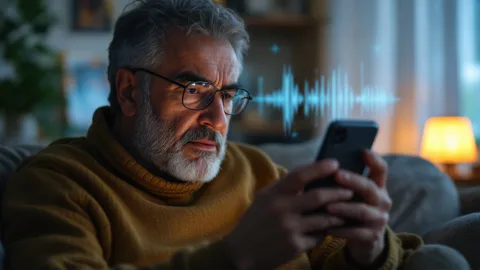
A familiar voice is not enough. Check suspicious requests through an independent call, family agreements and the right response after payment, without relying on definitive deepfake detection.
Examine content encryption, membership control and identity verification separately: a documented comparison of Livara, Signal, WhatsApp, SimpleX and Element.
Public visibility, encryption and content moderation are three different issues. Understand Livara’s channel boundaries and the key questions to ask before publishing.
Understand key distribution, per-message costs and membership changes in Sender Key architecture, alongside the documented boundaries of LGS1 and its scaling limits.
<-- slug: hybrid-ecdh-ml-kem-key-derivation-explained seotitle: One Key From Two Worlds: How a Hybrid ECDH + ML-KEM Encryption Key Is Derived seodescription: A step-by-step look at how hybrid post-quantum key exchange combines ECDH P-256 and ML-KEM-768 so every message key is derived from both world
WhatsApp backups are not necessarily plaintext. Check end-to-end encryption, recovery passwords or passkeys, and how chat backups differ from Livara identity recovery.
VPNs, HTTPS and end-to-end encryption have different boundaries. Learn what a VPN provider can see and why being free or paid is not, by itself, a measure of trust.
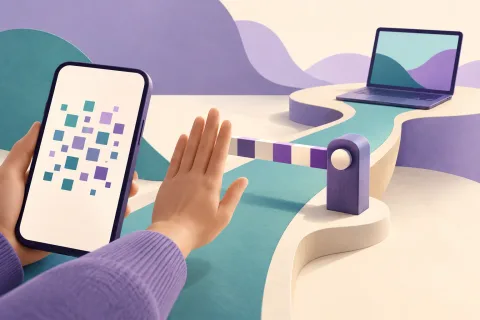
A QR code can open a fake login page or authorize an unwanted device. Learn how to distinguish linking from contact verification and respond to a mistaken approval.
How can a trusted root certificate affect HTTPS? Learn the difference between TLS and end-to-end encryption, web-app risks, and how to respond to certificate warnings.
Livara’s public channels do not have end-to-end encryption. Understand public posting, private chats, TLS, content moderation, and visible information.
Prompt injection can divert an assistant with chat access. Understand E2EE boundaries, necessary permissions, and practical controls to reduce data leaks.
A VPN changes the network path, while E2EE protects message content. Explore how they differ from HTTPS, the limits of metadata protection and Livara's actual encryption role.
A safety number is a human-readable fingerprint of the encryption keys behind a chat. Here is what comparing it out of band actually proves, why it changes, and why no warning flag can replace the ritual.
Attackers can record your encrypted chats today and unlock them later with a quantum computer. Learn what harvest now, decrypt later means and how hybrid post-quantum encryption with ML-KEM-768 protects messages sent now.
Transcription and translation do not necessarily undo chat encryption. Examine audio processing, service access, text retention, and output settings separately.
What does a safety number verify? Learn how to compare it with a contact, respond to key changes and distinguish manual verification from key transparency.
How can you check a fake administrator, a bogus prize or a cryptocurrency offer? A guide to stopping, verifying independently and protecting your account, including the limits of end-to-end encryption.
Pegasus and Graphite target devices, not just unlocked screens. Learn what the forensic reports show, where E2EE stops and how to respond to a spyware warning.
Web and Android clients can use the same protocol while exposing different risks. Compare extensions, updates, device access and installation verification.
MLS uses tree-based group key agreement; Livara describes a sender-key design. Compare membership changes, recovery, overhead and evidence without a false winner.
Understand client-side scanning and the limits of APK hashes, signatures and reproducible builds. A matching checksum is not proof that an app cannot scan you.
Removing a member from a chat needs more than a UI change. Learn how rekeying protects future messages and what LGS1 documentation does and does not establish.
How end-to-end encryption changes server-side AI access to private messages, and where channels, metadata, devices and optional AI features need separate review.
What can a messaging provider disclose? Separate server-held records, encrypted content, device access and backups without assuming E2EE means legal immunity.
Understand what SRP hides during login, why stolen verifiers still permit password guessing, and how authentication differs from chat encryption and recovery.
A stolen phone number can expose SMS login and recovery. Learn what protects messaging accounts, why old chats are a separate question, and what to do next.
Understand what a hotspot can see, how HTTPS differs from end-to-end encryption, and what to do about suspicious portals, certificate warnings and device risks.